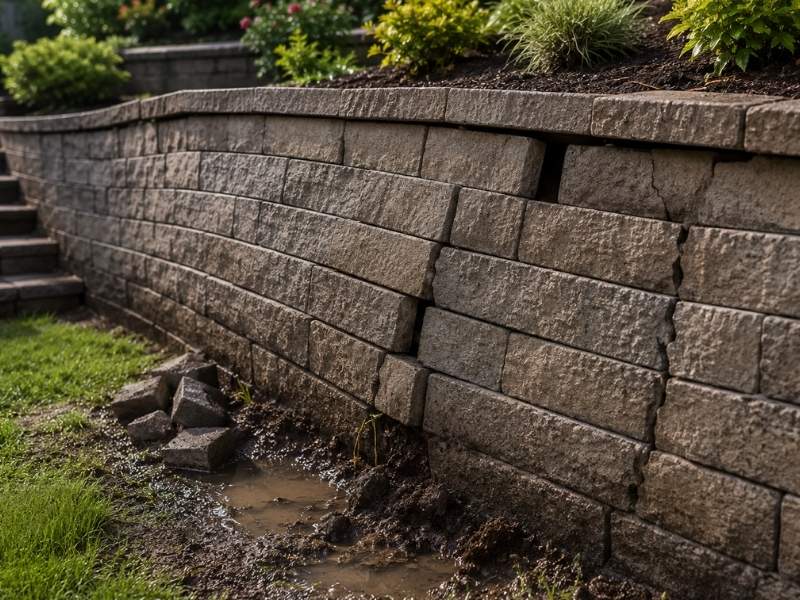
A retaining wall holds back a lot more than dirt. It holds back water, pressure, and the slope of your entire yard. When something goes wrong, the signs show up small at first. A hairline crack. A slight lean. By the time most homeowners notice, the problem has already been building for months. Catching these early signs saves you from a full wall rebuild later, and it starts with knowing exactly what to look for.
Why Retaining Walls Fail in the First Place
Most retaining wall problems trace back to one thing: water. Many retaining wall repair projects begin because poor drainage allows pressure to build behind the wall over time.
A wall’s main job is holding back soil. But soil holds water, and water adds weight. Without a way to drain, that weight pushes against the wall constantly. Over time, even a well-built wall starts to give.
Poor drainage is the most common cause. But soil type, wall age, and original construction quality all play a role too. Clay-heavy soil, common across parts of Birmingham, expands and contracts more than sandy soil. That movement stresses a wall in ways a homeowner never sees happening underground.
Early Signs a Retaining Wall Is in Trouble
Most retaining wall failures don’t happen overnight. They build slowly, and the early signs are easy to miss if you’re not looking for them.
Cracks That Weren’t There Before
A few hairline cracks in mortar joints are normal over time. But cracks that widen, run diagonally, or appear in a pattern across multiple courses of brick or stone are a different story. These often point to shifting pressure behind the wall, not simple age.
A Wall That’s Starting to Lean or Bulge
Run your eye along the top of the wall. Does it look straight? A wall that bulges outward in the middle, or leans forward at the top, is showing you where pressure has already won against the structure. This is one of the clearest signs that something behind the wall isn’t draining the way it should.
Water Pooling at the Base
Standing water right at the base of a retaining wall after rain is a warning sign. It means water isn’t draining through or around the wall properly. Instead, it’s sitting there, adding pressure and slowly weakening the soil and the wall’s foundation.
Soil Settling or Sinking Behind the Wall
Look at the ground just behind the wall. If it’s sinking, settling, or pulling away from the wall itself, water may be washing out fine soil particles from behind the structure. This creates hidden gaps that reduce the wall’s support over time.
Missing or Crumbling Mortar
Mortar joints that are crumbling, missing chunks, or feel soft when you press on them have lost their strength. This lets water infiltrate more easily, and it also means the wall has less structural integrity holding its individual stones or bricks together.
Why Drainage Is the Real Root of Most Problems
Almost every retaining wall issue traces back to how water moves, or fails to move, around the structure.
Weep Holes and What They’re Actually For
Small gaps built into a retaining wall, often called weep holes, exist for one reason. They let built-up water escape instead of pooling behind the wall. If these get blocked by dirt, debris, or plant growth, water has nowhere to go, and pressure builds fast.
Grading That Sends Water Toward the Wall Instead of Away
Sometimes the problem isn’t the wall itself. It’s the ground around it. If the yard grade slopes toward the wall instead of away from it, every rainstorm sends more water directly into the soil the wall is trying to hold back.
When a Small Repair Isn’t Enough Anymore
Some retaining wall problems are simple fixes. Others mean the wall has failed structurally and needs to come down.
Signs You’re Past the Point of Patching
A wall that’s leaning more than a couple inches out of plumb, or one with cracks running through multiple sections, usually can’t be patched back to safety. At that point, a mason needs to assess whether the wall can be reinforced or needs to be rebuilt from the footing up.
Why Waiting Makes the Fix More Expensive
A small drainage fix or repointing job today costs far less than a full wall replacement later. Once a wall fails structurally, everything behind it, patio, landscaping, sometimes even a portion of the yard itself, is at risk of shifting or collapsing along with it.
What to Do If You Spot These Signs
- Take photos of cracks, leaning, or pooling water so you can track whether the problem is getting worse over time.
- Clear any visible debris blocking weep holes, since this is sometimes an easy fix that reduces pressure fast.
- Check the grading near the wall to see if water is being directed toward it instead of away.
- Call a mason for an inspection if you notice leaning, bulging, or cracks that seem to be spreading.
- Don’t ignore small changes. A wall that looks fine one season can shift significantly by the next, especially after a wet winter.
Frequently Asked Questions
How can I tell if a retaining wall crack is serious?
Hairline cracks are often cosmetic, but cracks that widen over time, run diagonally, or extend across multiple rows of brick or stone may indicate structural movement. If the crack changes in size or new cracks appear, it’s a good idea to have the wall evaluated by a masonry professional.
Can a leaning retaining wall be repaired without rebuilding it?
In some cases, yes. A retaining wall with only minor movement may be stabilized or reinforced if the underlying structure remains sound. However, walls with significant leaning, foundation failure, or extensive damage often require partial or complete reconstruction.
Why does water cause so many retaining wall problems?
Water trapped behind a retaining wall increases pressure against the structure. Without proper drainage, this pressure can lead to cracking, bowing, leaning, or even wall failure over time.
What are weep holes, and why are they important?
Weep holes are small openings built into certain retaining walls to allow trapped water to drain from behind the wall. They help reduce hydrostatic pressure, improve drainage, and extend the life of the retaining wall.
How often should a retaining wall be inspected?
A visual inspection once or twice a year is recommended, especially after periods of heavy rainfall or severe weather. Regular inspections can help identify small issues early, making repairs simpler and less expensive.