Stone pavers are a popular way to do it because they work with patios, gardens, and built-in features of almost any style. The catch is that a connecting walkway has to fit several spaces at once, each with its own height, material, and drainage. Plan the route, the base, and the transitions first, and the stone choice gets much easier.
Most backyards already have a walkway. It’s the worn strip of grass between the back door and the grill, or the muddy line leading out to the seating area. People walk where it’s easiest, and a good masonry path makes that route permanent, dry, and good-looking.
Planning Walkway Routes Between Patios, Gardens, and Seating Areas
Start by mapping how people already move through the yard. Note the doors they use, where they carry food from the kitchen, and which areas get used most in the evening. A walkway that follows those habits gets used, while one that fights them gets cut across.
List the spaces the path needs to connect, such as a stone patio, an outdoor kitchen, a garden bed, a seating area, or an outdoor fireplace. Direct routes work best for daily trips like house to grill, while gentle curves suit garden strolls. Avoid tight turns, since people cut corners and wear down the edges.
Lay out the route with a garden hose or marking paint before deciding. Check for low spots where water collects, tree roots, utility lines, and slopes that may need steps. Elevation changes or a nearby retaining wall can shape the route as much as the layout does.
Choosing Stone Pavers That Complement Different Outdoor Living Spaces
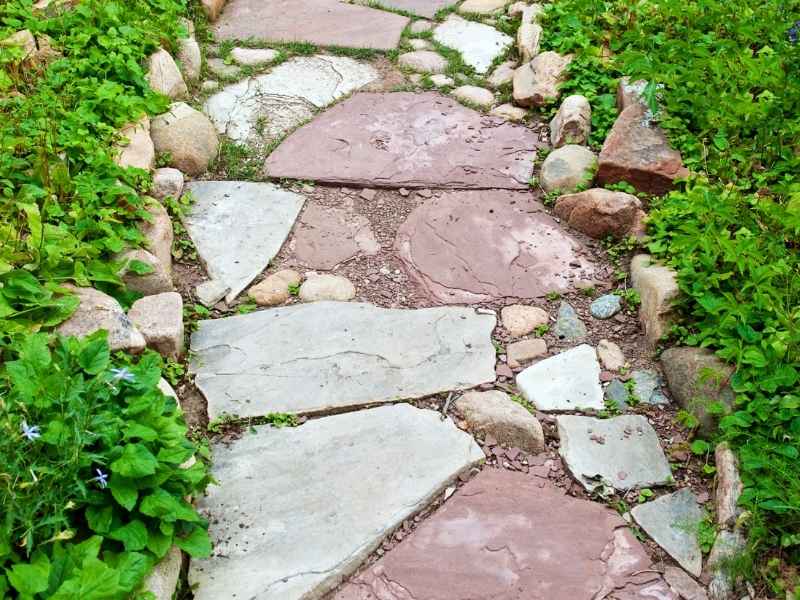
Natural stone comes in many types, each with its own color, texture, and feel underfoot. Common options include flagstone, bluestone, limestone, travertine, granite, and sandstone. Some are cut into uniform rectangles, while others are irregular pieces fitted together like a puzzle.
Let the spaces guide the choice. A formal entry or modern stone patio often pairs well with cut, consistent stone, while a garden or shaded seating area may suit irregular flagstone. If the home already has brick masonry or a brick patio, brick pavers or a warm-toned stone can tie the path to it. Neither material is always better, since the right pick depends on appearance, foot traffic, maintenance, climate, existing masonry, and budget.
Check a few practical details before you commit:
- surface texture, since smooth or polished finishes can get slick when wet
- heat, because darker stone can get hot in full sun
- thickness, which affects strength and how the stone is set
- porosity, since some stones absorb water and may need sealing
Ask to see samples wet and dry, in sun and shade, before ordering. Color can shift a lot once stone gets wet. A few pieces laid on site give a far better read than a photo.
Designing Walkway Widths and Patterns for Comfortable Movement
Width decides whether a walkway feels comfortable or cramped. Many designers start around 3 feet for a path one person uses at a time and widen to 4 or 5 feet where two people walk side by side. Main routes, like the one from the back door to an outdoor kitchen, usually deserve the extra room.
Plan for what moves along the path, too. Grills, wheelbarrows, coolers, and trash bins all need clearance, and plants along the edges tend to spill over and narrow the walkway with time. Leave a little extra width where beds will fill in.
Pattern changes how the path reads. Running bond and ashlar layouts with cut stone look orderly and suit formal spaces, while irregular flagstone feels relaxed. A border of brick or contrasting stone can frame the path and connect it visually to nearby stone masonry features.
Preparing Stable Bases and Drainage for Connecting Stone Walkways
A walkway is only as stable as what’s underneath it. For dry-laid stone pavers, crews typically dig out the soil, add a layer of compacted crushed stone, and top it with a thin bedding layer to set the stones. Base depth depends on soil type, foot traffic, and site conditions, so ask your contractor how they plan to build it.
Drainage is the other half of the job. The path should have a slight slope, often around a quarter inch per foot, so rain runs off instead of pooling on the stone. Water should head toward lawn, beds, or a drain and away from the house foundation or a retaining wall.
Edge restraints keep stones from drifting outward over time. Joints can be filled with polymeric sand, regular sand, gravel, or mortar depending on the installation. Mortared stone walkways need a concrete slab underneath, which changes cost and how repairs are made later. Evaluate drainage and base needs early, because fixing them after the stone is down means pulling it up.
Creating Smooth Transitions Between Pavers and Existing Outdoor Surfaces
Transitions are where walkways most often fail, either by tripping people or by trapping water. Every spot where the path meets a patio, step, lawn, or door should line up at a matching height or change level on purpose. Even a half-inch lip is easy to catch with a toe.
When joining an existing brick patio or concrete slab, check its height, slope, and condition first. Older surfaces may have settled, so the new stone may need adjusting or the old edge may need repair. A border course or threshold stone can make a clean break between materials that don’t quite match.
Slopes need special care. Gentle grades can often be handled with a sloped path, while steeper changes call for steps with consistent riser heights. If the walkway runs beside a retaining wall, keep digging away from the wall’s base and drainage, and have the wall checked if it shows cracks or leaning.
Frequently Asked Questions
Are stone or brick pavers better for a walkway?
Neither is always better. Natural stone offers varied colors and textures, while brick gives a classic, uniform look that matches many homes. The right pick depends on appearance, foot traffic, maintenance, climate, existing masonry, and budget. Seeing both options next to your home helps narrow it down.
How do I keep weeds out of the joints?
A solid base and properly filled joints are the best defense. Polymeric sand hardens and resists weeds better than loose sand, though it still needs occasional touch-ups. Clearing debris from the joints helps too, since seeds sprout in that buildup. Pull small weeds early before their roots spread.
Do natural stone walkways need sealing?
Some do and some don’t. Porous stones like certain limestones and sandstones can benefit from sealing to resist stains and moisture. Dense stones like granite often need little or none. Ask your mason which sealer, if any, fits your stone and how often to reapply it.