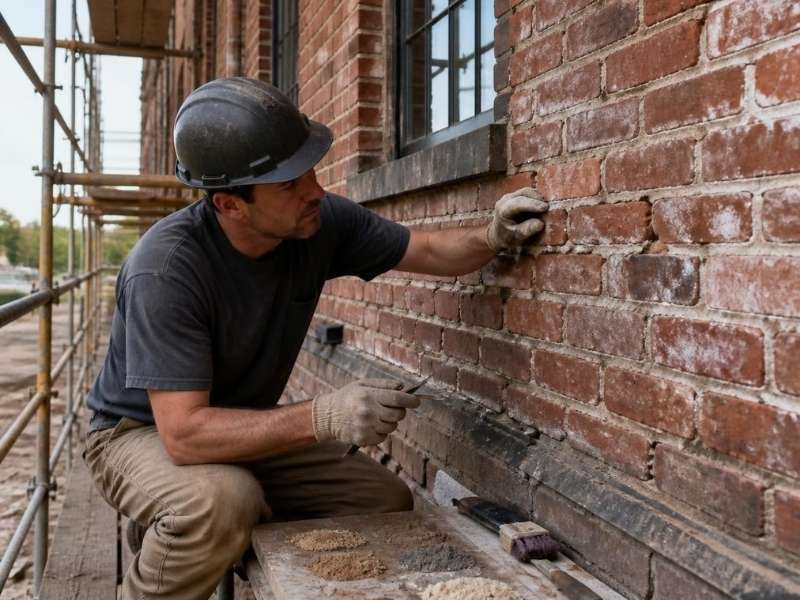
Brick masonry repointing decides whether a warehouse conversion holds up or starts crumbling within a few years. Birmingham has a real supply of old industrial buildings ready for adaptive reuse, from the Lakeview district to pockets of Avondale and the old Sloss-area warehouses. Most of them share the same problem: a century of mortar joints that were never built to handle a new life as apartments, offices, or retail.
This guide walks developers through what repointing actually involves and where warehouse conversions tend to go wrong.
What Repointing Actually Means
Repointing is the process of removing damaged mortar from between bricks and replacing it with new mortar. It’s not the same as tuckpointing, which is a decorative finish technique, and it’s not the same as sealing or coating a wall.
Done right, repointing restores the wall’s ability to shed water and stay structurally sound. Done wrong, it traps moisture inside the brick and speeds up failure instead of stopping it.
Why Warehouse Walls Need Extra Attention
Industrial brick walls in Birmingham are often thicker than typical residential brick, sometimes two or three wythes deep. That thickness hides problems. A mason can’t always tell how deep the mortar damage goes just by looking at the surface, and interior wythes can be crumbling even when the outer face looks fine.
Reading the Warehouse Before You Bid the Job
Before pricing repointing work, get a mason on site to assess the actual condition of the brick and mortar, not just the visible face.
What to Look For
- Mortar that’s soft enough to scrape out with a fingernail
- Vertical cracking running through multiple brick courses
- Efflorescence, the white powdery residue left by water moving through the wall
- Spalling brick, where the face has cracked off and fallen away
- Gaps at window and door openings where movement has occurred
Any of these signs point to repointing needs beyond a cosmetic touch-up.
Check for Structural Movement First
Some warehouse walls have shifted over the decades, especially near old loading dock openings or where floor loads changed. Repointing won’t fix a structural movement problem. If cracks are wider at the top than the bottom, or if a wall bulges outward, bring in a structural engineer before the mason starts any repair.
Matching Mortar to a Century-Old Building
This is where most warehouse conversions go wrong. Contractors show up with standard Portland cement mortar because it’s cheap and available. On old bricks, that’s a mistake.
Soft Brick Needs Soft Mortar
Warehouses built before the 1930s often used softer, more porous brick than what’s manufactured today. That brick needs a mortar that’s softer than the brick itself, so the mortar wears down over time instead of the brick.
Hard Portland cement mortar reverses that relationship. It becomes the strongest part of the wall, which forces the brick to crack and spall as the building moves and expands with temperature changes. This is one of the most common causes of brick face damage on old warehouse conversions.
Get the Original Mix Tested
A lab analysis of existing, undamaged mortar gives you the lime-to-sand ratio and any additives from the original build. Matching that mix keeps the new mortar compatible with the brick around it.
Sequencing Repointing on a Conversion Project
Repointing needs to happen at the right point in the construction schedule, not whenever it’s convenient.
The Right Order
- Complete structural assessment and any needed repairs first
- Repoint exterior walls before interior finishes go in
- Address roof and flashing issues before repointing, since active leaks will undo the repair
- Finish window and door installation after repointing around those openings
- Apply any approved sealant, if used, only after mortar has fully cured
Repointing before fixing an active roof leak is a common and expensive mistake. New mortar needs weeks to cure properly, and ongoing water intrusion can ruin the work before it sets.
Cutting Out Old Mortar Without Damaging the Brick
The removal process matters as much as the new mortar mix. Grinders and power tools can chip brick edges and widen joints beyond repair if the crew isn’t careful.
Hand Tools Over Grinders
Experienced masons use hand chisels or specialized grinding tools with depth guides on historic and older brick. This takes longer, but it protects the brick edges that a power grinder can easily chip. For a warehouse with hundreds of linear feet of joints, this adds real time and cost to the project, so it needs to be priced in from the start.
Cost Factors for Warehouse Conversions
Repointing costs vary by wall condition, wythe count, and access difficulty. A warehouse with scaffolding-only access or tight interior clearances will cost more per square foot than a simple single-story exterior wall. Budgeting a wall-by-wall assessment before the final bid helps avoid mid-project cost surprises once crews expose more of the wall.
Timing the Work Around Birmingham’s Weather
Mortar needs a set temperature range to cure properly, generally above 40 degrees Fahrenheit and below extreme heat. Birmingham’s summer heat and occasional winter cold snaps both affect scheduling. Late spring and fall tend to give masons the most workable conditions for repointing on an exposed exterior wall.
Frequently Asked Questions
What’s the difference between repointing and tuckpointing?
Repointing replaces deteriorated mortar to restore a wall’s structural performance. Tuckpointing is a decorative technique that creates the look of fine, precise joints, often applied over existing mortar for appearance rather than repair.
How do I know if a warehouse needs repointing before conversion?
Look for soft or crumbling mortar, vertical cracks across multiple brick courses, efflorescence, and spalling brick. A mason should assess the wall in person, since damage can run deeper than what’s visible on the surface.
Can repointing fix a bulging or leaning warehouse wall?
No. Repointing addresses mortar conditions, not structural movement. A wall that bulges or shows widening cracks needs a structural engineer’s assessment before any repointing work begins.
Why does mortar mix matter so much on old warehouse brick?
Old brick is often softer than modern brick and needs mortar that’s softer too. Standard Portland cement mortar is too hard, which forces the brick itself to crack instead of the mortar joint absorbing movement.
When is the best time of year to repoint brick in Birmingham?
Late spring and fall usually offer the most stable temperatures for proper mortar curing. Extreme summer heat and winter cold snaps can both interfere with how well new mortar sets.