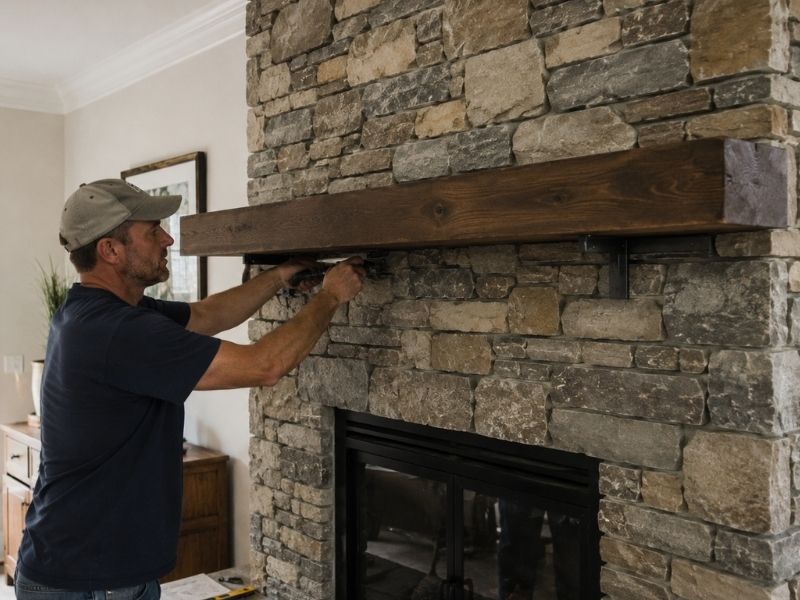
A stone fireplace looks solid from across the room, but that surface hides a lot of secrets. Homeowners often assume any wall anchor will hold a new mantel in place. That assumption causes more cracked stone and loose shelves than most people realize. Before you drill a single hole, it helps to treat the wall like a small construction survey. You need to know what the stone sits on, how thick it is, and where the weak spots hide.
How to Evaluate the Stone Fireplace Before Choosing a Mounting Method
The stone you see on the front of a fireplace is just a thin layer. Behind it sits a backing wall made of brick, block or even plywood and metal lath. That backing decides how strong your anchor points will be, not the pretty stone on top.
Start by figuring out what kind of stone you have. Natural fieldstone behaves differently than manufactured stone veneer. Natural stone is often thicker and denser, so it can handle deeper anchors. Manufactured veneer is thinner and can crack more easily under pressure.
Next, look at the mortar joints. Wide, deep joints usually mean sturdier construction. Thin or crumbly joints are a warning sign. Check the general condition too. Look for chips, hairline cracks or areas where stone pieces feel loose to the touch.
None of this takes long, but it changes everything about how you plan the mount.
Why Standard Anchors May Not Provide Enough Support for a Stone Fireplace
Plastic wall anchors and simple screws work fine on drywall. Stone is a different animal. Irregular surfaces make it hard for standard anchors to seat properly, so they can spin, crack or pull loose over time.
Think about the physics at play. A mantel doesn’t just sit against the wall. It sticks out several inches, sometimes more than a foot. That distance adds extra pulling force on every anchor point, and the further the mantel reaches out, the more that force multiplies where it’s fastened. A twelve pound mantel shelf can put far more stress on its brackets than its weight alone suggests.
Depth matters too. An anchor that barely grips the surface layer of stone or mortar won’t hold up against that kind of pull. You need fasteners that are rated for masonry, sized to reach solid material and spaced to spread the load across multiple points.
Skip this step, and you’re trusting a heavy shelf to hardware that was never built for the job.
Choosing Mounting Locations That Protect the Stone Fireplace Surface
Not every inch of a stone fireplace makes a good anchor point. Some areas sit right on solid backing. Others cover gaps, seams or old repairs that won’t hold weight no matter what hardware you use.
Before marking your holes, look closely at the surface. Skip any stone that feels loose, sounds hollow when tapped or shows cracks running through it. Areas near the firebox opening often see more heat and expansion over the years, so they may have shifted slightly out of place.
If you’re planning a bigger living room renovation in Birmingham, AL, this is a good moment to think about mantel placement as part of that larger project. A contractor who understands the whole room, not just the fireplace, can help you pick spots that support the mantel now and won’t cause problems once the rest of the renovation wraps up.
Good placement protects both the mantel and the stone underneath it.
How Custom Mantel Designs Affect Attachment Planning
Standard mantels bought off the shelf come with predictable weight and size. Custom designs change the math completely. A reclaimed wood beam can weigh three or four times more than a basic pine shelf of the same length. A deep floating mantel with no visible brackets puts even more demand on hidden hardware.
Floating mantels are especially tricky. Since there’s no visible bracket, the entire weight rides on a steel rod or bracket system buried inside the stone. That system has to match the exact thickness and density of your wall, or it simply won’t hold.
This is why mantel dimensions and materials should be settled before fabrication begins, not after. A carpenter building your custom piece needs to know what the wall can support so they can design brackets, rod placement and shelf depth around that limit.
Plan the mantel and the mounting system together, and you’ll avoid a lot of headaches later.
When Existing Stonework Should Be Inspected Before Mounting a Mantel
Sometimes the stone itself needs attention before a mantel goes anywhere near it. A few warning signs are easy to spot once you know what to look for.
Watch for stones that shift slightly when you press on them, cracks that run across multiple pieces instead of just one and mortar joints that crumble or leave gaps when touched. Water stains near the base can also point to moisture getting behind the stone, which weakens the whole structure over time.
If you notice any of these signs, it’s worth having the stonework checked before you add a mantel or anything else to the wall. Fixing loose stone or repointing old mortar now costs far less than repairing a fireplace after a mantel comes loose and takes chunks of stone with it.
For anyone planning a full living room renovation, this inspection fits naturally into the early planning stages. Handle the stonework first. Then build the finished look on top of a wall you can actually trust.
Frequently Asked Questions
Can you mount a mantel directly onto a stone fireplace?
Yes, but the method depends on the stone type, the backing material and the mantel’s weight. A quick inspection before drilling tells you which anchors and locations will actually hold.
What type of anchor works best for mounting a mantel on stone?
Masonry sleeve anchors or heavy duty concrete screws generally work best. The right choice depends on the stone’s thickness and what sits behind it, so a fastener rated for masonry beats a standard wall anchor every time.
Is it better to drill into the stone or the mortar joint?
Solid stone usually holds more weight than mortar joints, which can crumble under pressure. That said, thin or fragile stone isn’t always a good target either, so the backing material behind both should guide the final call.
How much weight can a stone fireplace support with a mounted mantel?
It varies widely based on the backing wall, the anchor type and how the weight spreads across multiple mounting points. A heavier or deeper mantel needs more anchor points, spaced further apart, to stay secure.
Can a floating mantel be installed on an existing stone fireplace?
Yes, though it takes more planning than a bracket mounted shelf. The hidden rod or bracket system has to match the wall’s thickness and strength, so this option usually works best when it’s planned early, before the stone goes up.