
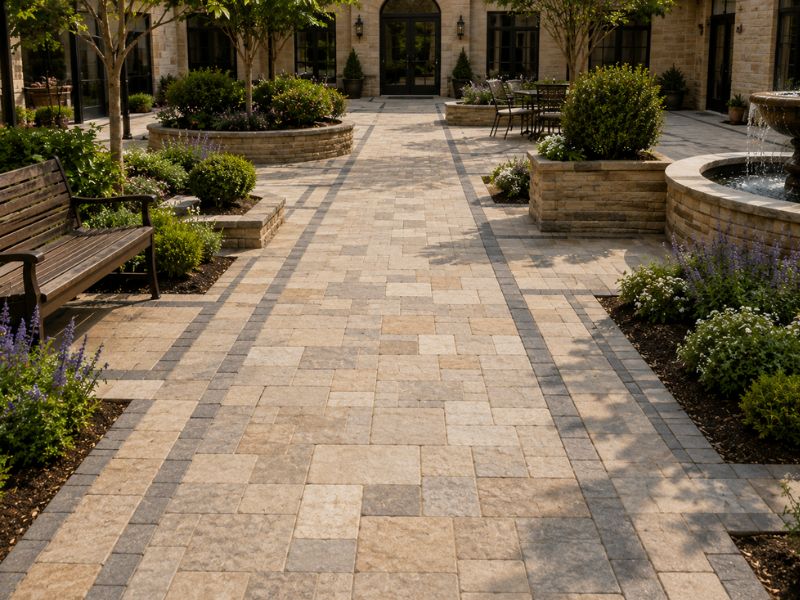
Stone pavers do more than look nice in a courtyard. They shape how people actually move through space. A good layout guides feet naturally from one spot to the next. A poor layout creates awkward turns and tight squeezes. It also creates spots where people bump into each other. Get the paver design right, and a courtyard feels easy to walk through, even during busy hours. Get it wrong, and small problems pile up fast. Uneven joints are one example. Pavers that shift underfoot are another. Here’s what matters most when stone pavers need to carry steady foot traffic every day, in every kind of weather.
Building Clear Paths Between Every Entrance
A courtyard often connects several places at once. There’s the building door, the parking area, and maybe a garden. There are also shared spaces where people gather. Stone pavers can link all of these points with direct, simple paths.
The goal is a route that doesn’t force people to backtrack. It shouldn’t send them on a strange detour either. Sharp turns and dead ends cause slowdowns. They also create spots where people walking from different directions run into each other. A well-planned paver layout avoids this. It keeps paths straight where it can. It curves only when there’s a real reason to.
Think about a courtyard with three entrances feeding into one central space. If the paver layout treats each entrance as its own island, people end up crossing paths at odd angles near the middle. Laying out the route as one connected system instead solves that problem before it starts. Everyone gets a clear, direct line to where they’re going.
Setting Joint Widths for Steady Footing
Joints are the small gaps between each paver. They seem minor, but they matter a lot for safety. Wide, sunken, or uneven joints can catch a narrow heel. They can also snag a cane tip. A stroller wheel or a wheelchair caster can get stuck too.
Keeping joints consistent and closely spaced makes the whole surface feel smoother underfoot. This isn’t just about comfort. A joint that’s too wide in one busy spot can turn into a real tripping risk over time. This is especially true where people move quickly or carry something in their hands.
Making Smooth Transitions at Doors and Walkways
A stone-paved courtyard rarely exists on its own. It connects to door thresholds, sidewalks, and ramps. It also meets other paved areas nearby. These connection points need just as much attention as the courtyard itself.
A sudden height change at a doorway can trip someone up before they even notice the courtyard beyond it. The same goes for a raised edge where the pavers meet a sidewalk. An awkward little step tucked into a walkway causes the same problem. Smooth transitions keep the whole path feeling like one continuous surface. Nobody wants it to feel like a series of separate pieces stitched together.
Keeping Pavers From Shifting Under Daily Use
Pavers near a busy entrance or gathering spot take a beating. Constant foot traffic pushes and pulls at the joints over time. Without the right support underneath, pavers can start to spread apart. They can also shift out of place.
A stable setting bed and solid edge restraints hold everything together. Edge restraints work like a frame around the paved area. They keep the outer pavers from creeping outward as people walk across them day after day. This matters most at entrances and crossing points. Anywhere a lot of people gather at once will see the heaviest wear.
A weak edge restraint might not cause trouble right away. The real damage tends to show up months later, once joints have widened enough to loosen the pavers next to them. Checking the perimeter construction before installation is far easier than pulling up a section of finished courtyard to fix a problem that started underground.
Placing Seating and Features Off the Main Path
Benches, planters, fountains, and bike racks add character to a courtyard. But if they sit too close to the main walking route, they can turn a wide, easy path into a tight squeeze.
Keeping these features clear of primary walking zones matters more during busy times. That’s when several people might be moving through the courtyard at once. It also matters for anyone using a wheelchair, walker, or stroller. A narrow gap that works fine for one person on foot might not work at all for someone who needs more room to pass. Planning enough clearance around these features keeps the courtyard comfortable, no matter how many people are using it.
Frequently Asked Questions
Are stone pavers suitable for heavily used courtyards?
Yes. Properly installed stone pavers can handle frequent foot traffic well. The base, joints, edges, and transitions all need to stay stable and even over time.
How wide should a pedestrian route through a courtyard be?
The right width depends on the property and any accessibility rules that apply. The route needs enough clear space for people, wheelchairs, strollers, and mobility aids to pass through safely.
Can uneven courtyard pavers be repaired individually?
Often, yes. A few pavers can usually be lifted and reset if the settlement is limited to a small area. Widespread shifting across a larger section may point to a deeper issue with the base or the edge restraints.
Why do courtyard pavers begin separating?
Separation usually comes from weak edge restraints or movement in the base. Lost joint material and steady pressure along a busy route can cause it too. Fixing the actual cause helps stop the problem from coming back.
Should stone pavers be level with adjoining sidewalks?
The two surfaces should meet through a smooth, well-planned transition. A sudden lip or a change in height can create a tripping hazard. It also makes the courtyard harder to move through.