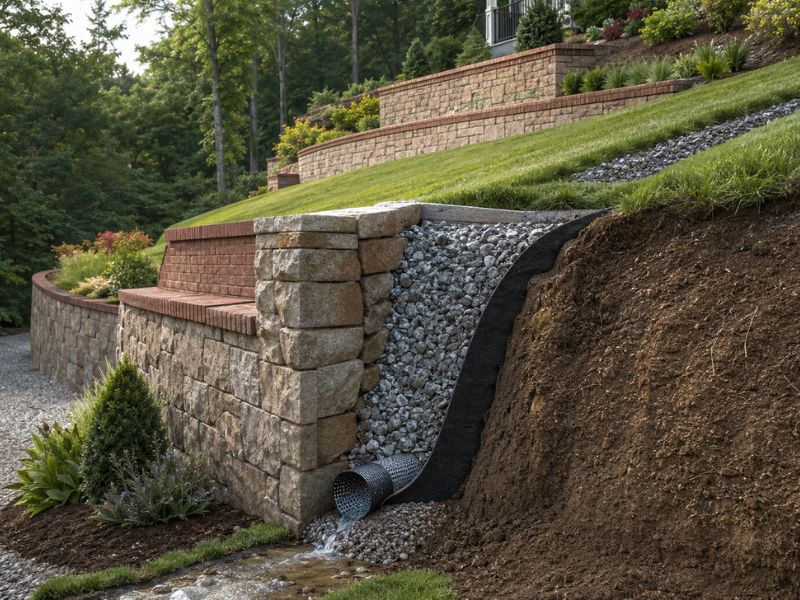
A retaining wall holds back soil on a slope. But soil isn’t the only thing pushing against it. Water is too, and water causes most of the damage that shows up years later. A retaining wall without good drainage can bulge, crack, or lean over time. This can happen even when the wall itself was built well, using solid brick and stone retaining wall materials and a proper footing. The fix isn’t just a bigger wall or thicker blocks. It’s a full drainage plan. That plan keeps water moving away from the soil instead of trapped behind it. Here’s what that plan actually needs to include on a hillside property.
Stopping Runoff Before It Reaches the Wall
Rain moving downhill picks up speed and volume as it goes. By the time it reaches a retaining wall, it can carry a lot of force. Many people assume the wall’s own drain will handle all of this water. That’s asking too much of one small pipe.
Swales, berms, and simple grading changes can catch this runoff higher up the slope. A surface drain can do the same job in a spot where water tends to collect. These tools redirect water around the retained soil instead of through it. Handling water before it ever reaches the wall takes a lot of pressure off everything built behind it. A well-placed swale near the top of a slope can do more for a wall’s long-term health than any upgrade made to the wall itself.
Building a Layer That Lets Water Move
Even with good surface drainage, some water will still reach the wall. This is where the drainage zone behind the wall comes in. Builders place clean, crushed stone directly against the back of the wall, from the base almost to the top.
This stone layer gives water a fast, open path straight down. Instead of soaking sideways into the soil, it drains quickly toward the base. Without it, water builds up and turns the soil behind the wall into a heavy, saturated mass. That wet soil pushes hard against the wall face, whether the wall itself is made of brick and stone, poured concrete, or engineered blocks. Over months and years, that pressure is often what causes a wall to bow outward or crack.
Placing the Drainpipe in the Right Spot
Water that moves down through the stone layer needs somewhere to go. That’s the job of the toe drain. This is a perforated pipe set near the base of the wall. It has to sit low enough to catch water arriving at the bottom of that drainage zone.
Getting this placement right matters more on some sites than others. A steep slope raises the stakes. So does soil that drains poorly, a reinforced wall, or a taller wall. These conditions often call for a more detailed drainage plan than a standard toe drain alone. A brick and stone retaining wall that looks simple from the front can still need careful planning behind it. This becomes even more true once the slope above it gets steep enough to send a real volume of water toward the base.
Giving the Water Somewhere Safe to Go
A drainpipe only works if it actually leads somewhere useful. Water collected behind the wall needs to discharge into a lower area, a stormwater system, or another approved outlet. A pipe that just ends at the base of a slope can create a new problem instead of solving the old one.
The discharge point needs some protection too. Erosion can eat away at the outlet over time. Nearby landscaping work can accidentally bury or crush the pipe. Soil can shift and block the opening. Small animals sometimes build nests right at the outlet. That blocks the flow just as effectively as a pile of dirt would. Checking this spot occasionally keeps the whole drainage system working the way it was designed to.
Handling Water Between Stacked Walls
Hillside properties often use two or more brick and stone retaining walls stacked in tiers rather than one very tall wall. This spreads the load across several shorter structures. But it also means water from the upper level has to go somewhere before it reaches the lower wall.
Runoff from an upper terrace shouldn’t just flow straight down onto the wall below it. That water needs to be caught and redirected at each level. Left alone, it will saturate the narrow strip of soil between the tiers. That soil is already under pressure from both walls, so extra water there raises the risk for the whole system, not just one section.
Frequently Asked Questions
Does every hillside retaining wall need a drainpipe?
Not every small wall uses the same setup, but brick and stone retaining walls on slopes, walls in poorly draining soil, reinforced walls, and many walls over four feet tall commonly need a toe drain or a full drainage plan.
Can surface grading replace drainage behind the wall?
No. Surface grading redirects runoff before it reaches the retained soil. The drainage layer and pipe handle water that still gets through. Both systems work toward the same goal in different ways.
Where should retaining wall drainage water discharge?
The outlet should lead to a safe lower area, an approved stormwater connection, or another spot built to receive the flow without causing erosion or new water problems nearby.
Why is filter fabric used in retaining wall drainage?
Filter fabric keeps fine soil particles separate from the drainage stone. It also helps protect weep holes, lowering the chance that soil will work its way into the drainage path and clog it.
Should downspouts empty behind a hillside retaining wall?
No. Roof runoff needs to be routed away from the retained soil instead of dumped behind the wall. Any concentrated water source like this should be identified and handled as part of the full site drainage plan.