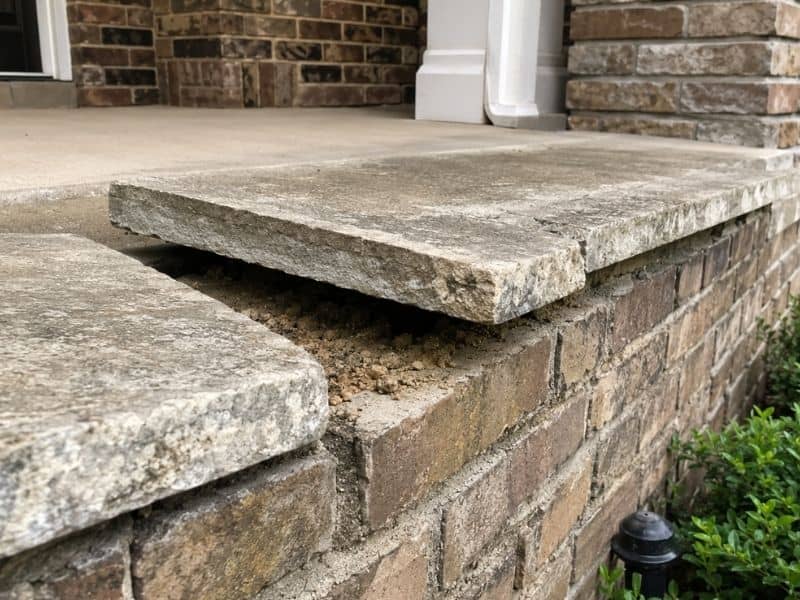
A loose cap on a porch wall is not something to ignore. If you own an older home, you may have noticed a stone or brick cap that wobbles or looks out of place. A stone mason can check the wall and tell you if the cap needs to be reset. This kind of check often starts with a simple construction survey of the porch wall, the caps, and the ground nearby. Many homes built with brick and stone in this area show wear after years of rain, heat, and shifting soil.
How to Tell When a Porch Wall Cap Has Become Loose
A loose cap does not always look broken. Sometimes it just feels wrong under your hand. If you press down on a cap and it rocks or wiggles, that is a clear sign it has come loose from the wall below it.
Look closely at the joints between the cap and the wall. A tight joint should be even all the way around. If you see a gap on one side, or the joint looks wider than it used to be, the cap has likely shifted.
Some caps pull away from the wall in small steps. You might notice a thin line of space where the stone no longer sits flush against the brick or block underneath. This kind of separation often happens slowly, so it is easy to miss until the movement becomes obvious.
A loose cap can also shift sideways, so it no longer lines up with the caps next to it. Once you spot uneven spacing or a cap that sticks out further than its neighbors, it is worth a closer look. Loose coping like this can create a falling-masonry concern, especially when the movement is easy to see or feel by hand.
Why Older Porch Walls on Sloped Lots Put More Stress on Stone Caps
Many porch walls in older Birmingham neighborhoods sit on ground that is not flat. Homes built decades ago often used whatever grade the lot offered, and builders did not always plan for how the soil would move over time.
On a sloped lot, water drains unevenly around the base of a wall. This uneven drainage can lead to slow settlement, where one section of the wall sinks slightly while another stays put. That kind of movement travels upward through the wall and often shows up first at the top, right where the caps sit.
Older mortar also tends to lose strength faster than newer mixes. Combine weaker mortar with a wall built on a slope, and the upper courses take on more stress than they were designed to handle. This is a common pattern in this region’s older homes, and it explains why so many porch caps loosen with age rather than failing all at once.
What Happens When Water Gets Beneath a Loose Wall Cap
Once a cap loosens, even a small gap can let rainwater slip underneath it. That water does not just sit there. It works its way down into the wall, soaking into the mortar joints and the stone or brick below.
Over time, this trapped moisture weakens the material that holds the wall together. In colder months, water that freezes inside these gaps can expand and push the joints apart even further. That cycle of freezing and thawing tends to speed up existing damage.
A properly set cap is meant to shed water away from the wall surface, not let it soak in. When a cap sits flush and tight, rain simply runs off the edge and drips clear of the masonry below. A loose cap breaks that protection, turning a small crack into an entry point for ongoing water damage.
When a Brick Stone Mason Should Reset the Existing Cap Instead of Replacing It
Not every loose cap needs to be thrown out and replaced. If the stone itself is still solid, with no deep cracks or crumbling edges, a brick stone mason can often remove it, clean off the old bedding material, and set it back in place with fresh mortar.
This approach only works when the cap has held up well over the years and the problem is really about what is underneath it, not the stone itself. Failed bedding material is one of the most common reasons a sound cap starts to rock or shift.
Before resetting anything, a mason should check the cap closely, along with the surface it sits on and the masonry right next to it. This kind of inspection is standard practice in masonry repair, where a loose but otherwise intact capstone is usually treated as a good candidate for removal, cleaning, and reinstallation rather than full replacement.
Why Loose Porch Wall Caps Should Be Addressed Before More Stones Shift
One loose cap rarely stays a problem on its own. As it continues to rock or shift, it puts uneven pressure on the caps beside it. Over time, that pressure can loosen stones that were once solid.
A wall’s upper section depends on each cap fitting tightly against the next one. Once that connection breaks down in one spot, the whole row loses some of its strength and its ability to keep water out.
Catching a loose cap early gives you a much simpler repair. It also means the original stone can often be saved and reused, which matters on older porches where matching stone can be hard to find. Waiting until several caps have shifted, or until the masonry underneath starts to show damage, usually turns a small fix into a much bigger project.
Frequently Asked Questions
How do I know if a porch wall cap needs to be reset?
Some wear is normal on an older porch. A cap that needs attention will actually move when you press on it, show a clear gap along one edge, or have joints that have visibly widened compared to the caps around it.
Can a loose stone cap be reset without replacing it?
Yes, in many cases. If the stone is still structurally sound and the problem is failed bedding material underneath, a mason can usually clean it, reset it, and reuse the original stone. Caps that are badly cracked or crumbling often need to be replaced instead.
Why do stone caps become loose on older porch walls?
The most common causes are worn-out bedding material, years of weather exposure, small amounts of movement within the wall itself, and general aging of the mortar. This is separate from larger issues like retaining wall failure or drainage problems elsewhere on the property.
Does a sloped lot make loose porch wall caps more concerning?
It can. Uneven ground often leads to slow settlement, and older masonry on a slope tends to show that movement first at the top of the wall. An inspection is especially useful on sloped properties for this reason.
Can a loose wall cap allow water into the masonry?
Yes. Gaps beneath or between coping stones give rainwater a direct path into the wall. Caps that are set correctly are positioned to shed that water away from the surface instead of letting it soak in.