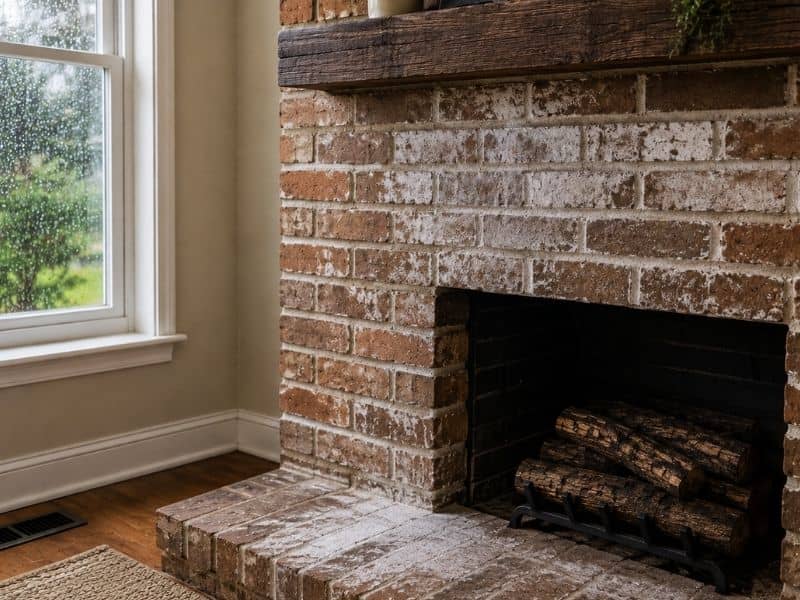
Does your brick fireplace smell musty even on a dry, sunny day? You are not alone. Many homes deal with this problem, especially after a long stretch of rain. A brick fireplace can hold onto water inside its pores, and that trapped water is often the real reason for the smell. The odor is not always a sign of dirt or a dirty chimney. Most of the time, it means the brick itself is still wet on the inside, even though the outside looks fine.
Why Humid Alabama Air Can Keep a Brick Fireplace Smelling Damp
Alabama summers are hot and sticky. That humid air plays a big role in how long a brick fireplace stays damp. Brick and mortar are porous. That means they are full of tiny holes, like a sponge. Rain soaks into those holes, and on a normal dry day, the water slowly leaves the brick and dries out.
But when the outside air is already full of moisture, that drying process slows way down. The brick cannot release water into air that is already soaked with it. So the moisture just sits there, inside the wall. This is when you get that damp, musty smell. It can also lead to white, chalky marks on the brick surface. Those marks form when water carries minerals out of the brick as it tries to escape. In Central Alabama, where summer humidity often stays high for weeks, this slow drying cycle can repeat again and again.
How Moisture Gets Into a Brick Fireplace During Heavy Rain
A lot of homeowners assume rain only touches the outside of the chimney. That is not true. Water can find its way into a brick fireplace through several paths that are easy to miss.
One common spot is the area where the chimney meets the roof. This joint is sealed with flashing, a thin strip of metal. If that flashing is old, bent, or cracked, rain can slip right through it and soak into the brick below. Cracked mortar joints are another weak point. Even a small crack lets water push deep into the wall during a heavy storm.
Damaged or missing chimney caps also cause trouble. Without a cap, rain falls straight down into the flue and soaks the inner brick. And on older homes, brick that has lost its water repellent coating soaks up rain much faster than brick that still has protection. Once water gets past these weak spots, it settles inside the masonry and stays there far longer than most people expect.
Why the Damp Smell Can Remain After the Bricks Look Dry
Here is something that surprises many homeowners. Brick can look completely dry on the surface while still holding a large amount of water deep inside. A quick touch test does not tell the whole story.
Think of brick like a thick towel. If you dry only the top layer, the middle can still be soaked. Brick works the same way. The outer layer dries fast because it gets direct air and sunlight. But moisture in the center of the wall has to travel a much longer path to escape. That process can take days or even weeks, depending on how thick the wall is and how much water it absorbed.
This is why a fireplace can smell fine right after it rains, then start smelling musty again a day or two later. The surface dried first, but the moisture trapped deeper inside is still working its way out. Until that inner moisture fully leaves the wall, the smell is likely to return.
Signs That a Musty-Smelling Brick Fireplace May Have a Moisture Problem
A damp smell rarely shows up alone. There are usually other clues nearby, and they are worth paying attention to.
Watch for these signs around your fireplace:
- White, powdery deposits on the brick, known as efflorescence
- Dark or discolored patches that show up after rain
- Mortar that looks crumbly, soft, or is starting to fall out
- A musty smell that returns again and again after wet weather
- Brick that feels cool and damp to the touch even on warm days
Efflorescence deserves extra attention. A little bit after a heavy storm is normal and often harmless. But if it keeps coming back over and over, it usually means water is still moving through the brick on a regular basis. That is not a surface issue you can wipe away for good. It points to moisture that keeps entering the wall from somewhere.
When a Damp-Smelling Brick Fireplace Needs a Closer Inspection
A single musty smell after one big storm is usually nothing to worry about. Brick can absorb rain and dry out over the following days. But a smell that keeps coming back after every rain is a different story.
If the odor shows up again and again, or if it appears along with cracked mortar, shifting bricks, or repeated white deposits, it is time for a closer look. These signs together often point to an ongoing moisture source, not a one-time soak. That source could be damaged flashing, a missing cap, open mortar joints, or a coating that has worn away.
Painting over stains or cleaning the brick surface will not fix a hidden moisture problem. The smell will simply come back once conditions turn humid again. Finding where the water is actually getting in gives you a real answer, not a short-term cover-up.
Frequently Asked Questions
Does a brick fireplace normally smell damp after rain?
A short-lived musty smell can happen when porous brick absorbs rain and slowly dries out. That part is normal. But if the smell keeps returning after several rain events, it is worth taking seriously instead of ignoring it.
Why does my brick fireplace smell musty in summer?
Central Alabama summers bring thick, humid air that slows down how fast brick can dry. Moisture that soaked in during a storm has nowhere to go, so it lingers inside the wall and keeps producing that musty smell.
Can rainwater get inside a brick fireplace?
Yes. Rain can enter through cracked mortar joints, damaged chimney flashing, a missing or broken chimney cap, or brick that has lost its protective coating. These small openings let water travel deep into the masonry.
What does white residue on brick fireplace masonry mean?
Those white, powdery marks are called efflorescence. They form when water moves through brick and carries minerals to the surface as it evaporates. Repeated efflorescence often points to moisture that keeps traveling through the wall.
Should I be concerned if the damp smell keeps returning?
Yes. A smell that shows up after nearly every rain usually means there is an ongoing moisture source somewhere in the masonry. At that point, it makes sense to have the fireplace and chimney looked at closely before the moisture causes more damage.